Designing a Low-Bandwidth Government Website for Remote Island Access
Design, develop and transfer a responsive and low bandwidth website for the Ministry of Youth and Sports in 6 months.

Role on the team: Owned the full product design process, partnering closely with stakeholders to shape the experience strategy, and deliver the website.
My deliverables: Workflow prototypes to validate and align, design systems, content creation, sustainability training.
Agency: Peace Corps Vanuatu
Immersing in Context and Constraints
During my second stint in the Peace Corps, I served as a Web Design and Development Consultant in Port Vila, Vanuatu for six months. I partnered with the Ministry of Youth and Sports, a national government agency, to modernize their digital presence under real-world constraints, limited infrastructure, remote access, and short delivery timelines. This engagement required more than designing a website, it required building trust, aligning stakeholders, and delivering a solution the Ministry could sustain long after my departure.


Discovery: Aligning Stakeholders and Defining Success
The goal was to create a responsive, low-bandwidth website that could be reliably accessed from remote islands across the country. Equally important was ensuring the Ministry could manage and update the site independently once the project ended.
Early on, I focused on stakeholder alignment—spending time with leaders and team members across the national government to understand:
The Ministry’s mission and priorities
How communities accessed information in-country
What content mattered most to citizens
What “success” looked like for both the Ministry and the public
This groundwork helped build trust and buy-in, ensuring the final solution met both user needs and organizational realities.


Designing for Real-World Environmental Limitations
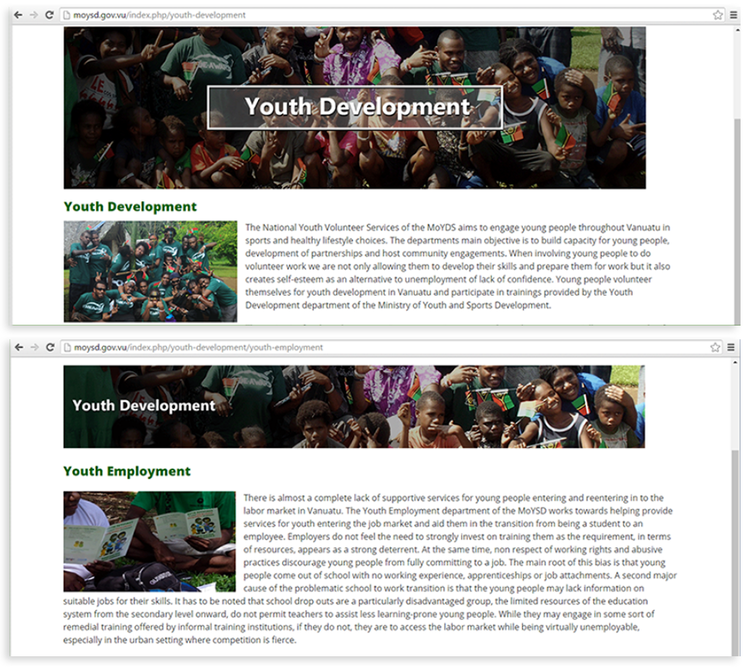
All government offices in Vanuatu use Joomla as their CMS, so the solution needed to work within that system while also supporting the realities of the region.
3G network performance on remote islands
Low data usage (minimal media and reduced page weight)
Fewer clicks and faster access to critical information
Clear navigation and structure, even with limited screen space
To support long-term consistency, the UI was built on a lightweight design system that scaled from primary pages to secondary pages using shared layout patterns and reusable components. One of the most challenging parts of the project was content gathering across 40+ islands, many with limited internet access, requiring flexibility in process, strong communication, and careful prioritization.

Training for Sustainability and Long-Term Ownership
Because the project had a limited in-country timeline, sustainability was a core part of the work, not an afterthought. I trained three employees on:
Updating and publishing content in Joomla
Maintaining the navigation and page structure
Managing the social media channels we established
The training was recognized as highly successful by national leadership, which led to a broader initiative: a government-wide training for 50 employees, offering professional development in the fundamentals of web design and digital content management.

Impact
Delivered a responsive, low-bandwidth government website accessible across remote regions
Established a sustainable content model within Joomla
Enabled long-term ownership through training and documentation
Expanded training into a government-wide digital skills program for 50 employees
Related Publications